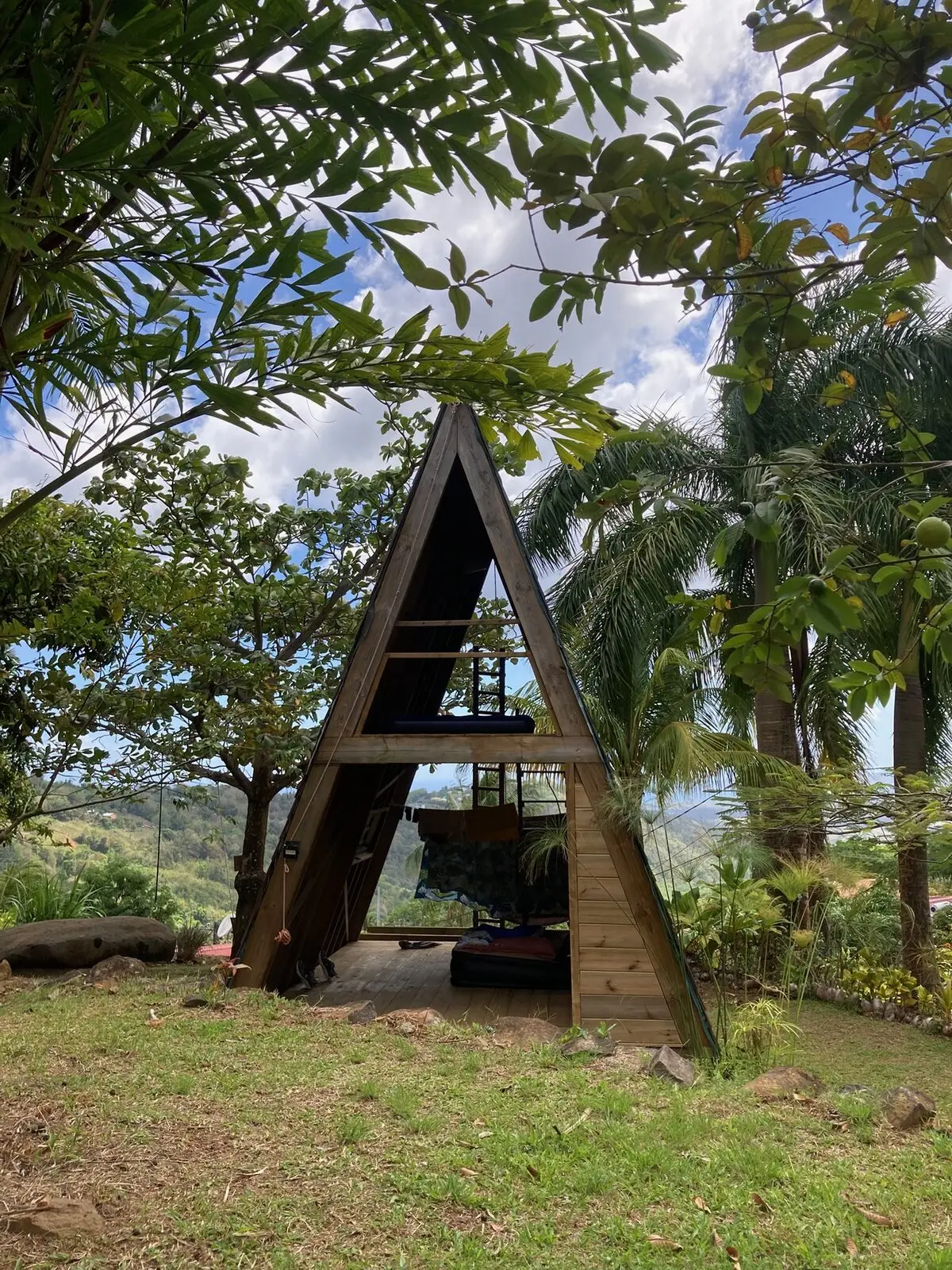
We’re on the route de Zaïre, in the hills above Sainte-Luce. Not close to the beach — you need a car to get there, five or ten minutes down the hill. But up here, in the middle of the countryside, it’s quiet in a way you don’t find near the coast.
The neighbourhood is small and rural. Everyone knows everyone. There are coqs crowing from four in the morning — that’s not a selling point exactly, but it’s honest. The kind of place where a neighbour will leave fruit at the gate, and you leave mangoes back. There’s also a custom here worth knowing: in the morning, when someone leaves for work, they give a short honk. The neighbour answers — just a “hé” — to say they heard. Everyone watches out for everyone. We always tell guests to listen for it.
The view opens in two directions: the Femme Couchée and the Rocher du Diamant on one side, Sainte-Luce on the other — framed by a mango tree, through an open layout that catches every breeze.
We’re five minutes from the Forêt de Montravail — one of the oldest forests in Martinique, cool and shaded with enormous mahogany trees, good for walking, good for doing nothing in particular. The Roches Gravées are close too: Amerindian petroglyphs carved into andesite, 14 faces looking out from the rock face, classified as a historical monument. You can walk there in twenty minutes from the house.
There are no loud neighbours, no through-traffic, no tourist buses. The road ends not far past us.
On Saturday mornings, the market in Sainte-Luce has everything you need — tomatoes, christophines, fresh bananas, good prices. Rivière-Pilote market is also worth the detour.
People come expecting a beach resort and find something else — somewhere to actually stop, where the days slow down and the garden does the entertaining.